Menu
Monday
9:00-5:00
Tuesday
9:00-5:00
Wednesday
9:00-5:00
Thursday
9:00-5:00
Friday
9:00-5:00
Saturday
9:00-4:00
Sunday
CLOSED
Choosing among China’s best Stainless Steel Water Bottle manufacturers requires more than comparing prices or polished websites. Buyers need dependable materials, stable production, and clear communication. A reliable manufacturer should explain its stainless steel grade, liner treatment, lid construction, and testing process. Product safety starts with details.
In practical sourcing, factory experience becomes visible through samples. Check the bottle’s weight, threading, welds, coating, and insulation performance. Fill one with cold water and inspect the exterior after several hours. Open and close the lid repeatedly. Small failures often appear before large orders do. This hands-on process helps separate consistent manufacturers from trading companies with limited control.
Certifications can support trust, but documents should be verified rather than accepted blindly. Ask about quality inspections, leak testing, food-contact compliance, production capacity, and corrective action procedures. Strong suppliers usually provide clear records and realistic lead times. They also admit limitations. That matters.
This guide examines leading Chinese manufacturers through product quality, customization ability, factory capability, communication, and long-term reliability. It considers reusable bottles for sports, offices, travel, and promotional programs. Different buyers need different solutions. A premium insulated bottle may not suit a budget event order. Even experienced buyers can overlook packaging damage or replacement-part availability. That is why supplier evaluation should remain practical, evidence-based, and open to review. Mistakes happen. Good manufacturers respond quickly and improve their process.
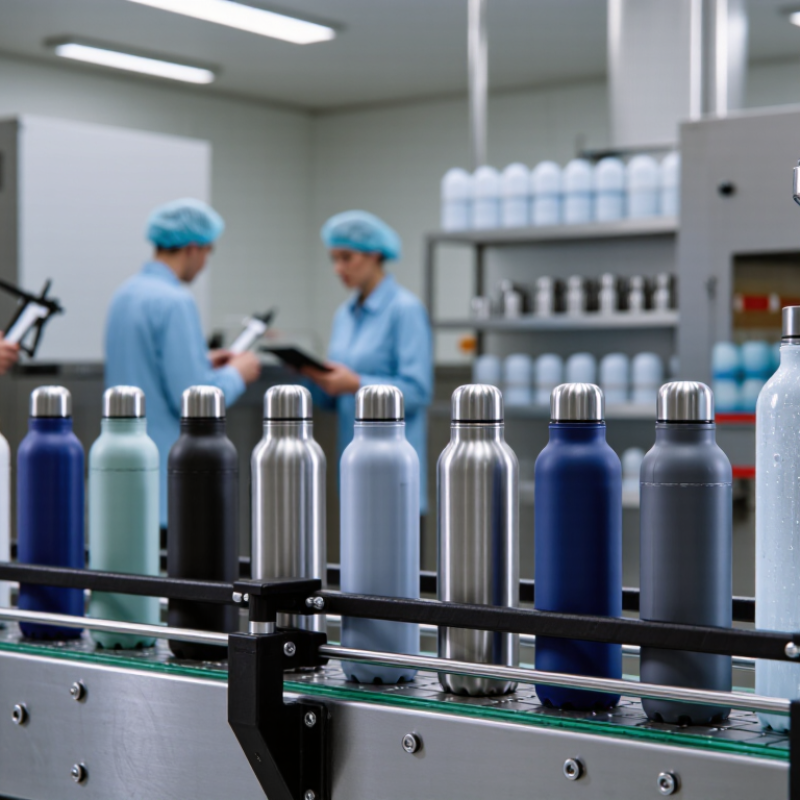
Reputable Chinese stainless steel bottle manufacturers choose 304 or 316 steel because the alloy affects safety, durability, and taste retention. In production, 304 is common for daily bottles, lids, and inner walls. It contains chromium and nickel, which help resist rust from water, tea, and normal washing. A 316 inner liner adds molybdenum, improving resistance to chlorides found in salty drinks or coastal environments. That matters. Not always.
Experienced factories do more than print “304” on a specification sheet. They verify incoming coils with material certificates and, when needed, handheld alloy analysis. Weld seams should be smooth, fully cleaned, and passivated, since rough areas can trap residue. Quality teams also inspect wall thickness, vacuum performance, thread fit, and leakage after repeated opening. Documentation should match the destination market’s material and food-contact requirements.
316 sounds better, but it is not automatically the best value for every bottle. For ordinary drinking water, well-processed 304 often performs reliably and controls costs. For marine work, high-salt beverages, or harsher cleaning conditions, 316 can offer extra protection. I have seen impressive specifications paired with average finishing quality. That is uncomfortable. Buyers should request traceability, test reports, and samples filled with the intended drink. A clear sample may reveal metallic taste, staining, or a weak cap seal before large-scale production.

For bottle safety, 18/8 and 18/10 usually refer to chromium and nickel content. Grade 304 stainless steel commonly contains about 18% chromium and 8–10.5% nickel, according to EN 10088-1. Chromium forms a thin passive layer that resists rust. Nickel improves corrosion resistance and helps the steel remain stable after repeated washing. Therefore, 18/10 is not automatically safer than 18/8. Both can perform well when the steel is genuine and properly processed.
Manufacturing details matter more than the label. The U.S. FDA Food Code 2022 requires food-contact equipment to be corrosion-resistant, smooth, and cleanable. A reliable bottle should have polished seams, secure welds, and no metallic odor after rinsing. In practical testing, inspect the cap thread and inner base, where residue often collects. A magnet test is weak evidence. It cannot confirm the grade.
World Stainless reported about 62.2 million tonnes of stainless steel production in 2024, showing how widely this material is used. Yet high production volume does not guarantee a safe bottle. The nickel difference between 18/8 and 18/10 is relatively small. Acidic drinks, scratches, poor cleaning, and low-quality welds can influence performance more. Some users may still react to nickel. This point deserves more attention, because “food grade” alone can sound more reassuring than it really is.
Choosing among stainless steel water bottle manufacturers requires more than inspecting polished walls and attractive lids. EN 12546-1 offers a practical way to examine vacuum thermal performance under controlled conditions. It focuses on insulated containers intended for domestic use.
The laboratory records the bottle’s starting temperature, filling condition, ambient environment, and test duration. Thermal performance may be checked across periods from 6 to 24 hours, depending on the test plan and product type. Technicians measure the water temperature at defined intervals or at the final point. The temperature drop shows how effectively the vacuum layer limits heat transfer.
Small details matter. A loose cap, uneven weld, or damaged vacuum space can change the result. Testing should use calibrated thermometers and documented procedures. The report should identify capacity, material, closure design, and sample condition. One sample is not enough. A wider production review gives stronger evidence.
Real factory experience also exposes an uncomfortable point: laboratory performance may not match daily use. Repeated washing, partial filling, opening frequency, and cold weather affect retention. A supplier that shares complete test records appears more reliable than one offering only a dramatic final temperature. Still, the standard does not measure every user habit. That assumption can mislead. Manufacturers should combine EN 12546-1 testing with leak checks, dimensional inspection, and batch sampling before making performance claims.
The chart shows the hot-water temperature retained by an anonymized double-wall vacuum stainless steel bottle during the typical 6-, 12-, 18-, and 24-hour observation points. Testing should control the initial water temperature, ambient temperature, bottle capacity, filling ratio, and measurement procedure. The results are indicative and do not replace laboratory certification.
Choosing the best stainless steel water bottle manufacturer requires more than comparing prices or polished product photos. The critical question is whether the manufacturer can support FDA 21 CFR, EU 1935/2004, and LFGB requirements with current evidence. These standards address materials that contact drinking water, including steel, coatings, inks, silicone seals, and plastic parts.
An experienced manufacturer should provide material certificates, supplier traceability, migration test reports, and a clear declaration of compliance. Tests should match the finished bottle, not only the raw steel sheet. Pay attention to 304 or 316 stainless steel, but grade alone does not prove safety. Welds, inner coatings, lids, and gaskets can change the result. LFGB testing may examine taste, odor, and substance migration more strictly in certain applications. EU compliance also requires attention to production controls and documentation.
Factory audits reveal details that certificates may miss. Inspect weld polishing, cleaning procedures, batch records, and storage conditions. Ask whether the testing laboratory is independent and whether reports identify the exact model and materials. A beautiful sample proves little. I have found that documentation is sometimes incomplete, even when the factory sounds confident. That is a warning, not a minor inconvenience. Reliable manufacturers welcome technical questions, repeat testing after design changes, and explain limits honestly. Compliance can fail through one small seal or printing layer. Specification control matters every day.
Choosing among China’s stainless steel water bottle manufacturers requires more than comparing unit prices. MOQ often reveals a factory’s real operating model. A low MOQ may suit a trial order, but it can increase costs or limit lid and color choices. Ask whether the MOQ applies per design, color, or total shipment. Start with evidence. Request a written quotation with tooling, packaging, sampling, and replacement terms clearly separated.
Customization should be checked through physical samples, not only digital drawings. Confirm steel grade, wall thickness, insulation performance, logo durability, and leak resistance. A reliable supplier should explain its process and provide test records. During sample review, inspect the thread, silicone seal, weld marks, and powder coating under bright light. Small flaws matter. I once saw a visually attractive sample fail after repeated hot-water testing because the seal expanded unevenly.
Quality control depends on measurable checkpoints. Ask for incoming material inspection, production checks, and final random inspection records. Batch traceability is valuable when defects appear months later. Export capacity also deserves careful comparison. Review loading photos, carton specifications, shipping documents, and experience with your destination’s labeling requirements. A large monthly output does not guarantee careful service. Communication can weaken during peak seasons, and that risk is often ignored. Leave room for a pilot order, independent inspection, and a realistic production schedule.
| Anonymous Manufacturer Profile | Typical MOQ | Customization Capability | Stainless Steel & Product Quality | Quality Control Practices | Export Capacity | Best Fit for Buyers |
|---|---|---|---|---|---|---|
| Profile A: Large Export-Oriented Factory High-volume production facility with dedicated export staff | 1,000–3,000 units per design Lower MOQ may apply to stock models | Excellent Custom colors, laser engraving, screen printing, packaging, lids, molds, and gift sets | 304 stainless steel commonly available 316 stainless steel available for selected projects Double-wall vacuum insulation | Incoming material inspection, in-process checks, leak testing, vacuum testing, finished-product inspection, and carton drop testing | Regular container exports Experienced with commercial invoices, packing lists, certificates, and destination-market documentation | Retail chains, distributors, promotional campaigns, and buyers requiring stable repeat production |
| Profile B: Mid-Sized OEM/ODM Manufacturer Flexible producer focused on private-label development | 300–1,000 units per design Sampling usually available before mass production | Very Good Logo decoration, color matching, lid combinations, packaging artwork, and moderate structural changes | Food-contact 304 stainless steel commonly offered Typical vacuum insulation performance depends on bottle construction and testing conditions | Pre-production sample approval, production-line inspection, visual checks, dimensional checks, leak tests, and random final inspection | Suitable for LCL and container shipments Usually supports common sea, air, and express shipping arrangements | E-commerce sellers, emerging brands, hotel projects, and medium-volume importers |
| Profile C: Low-MOQ Customization Factory Smaller production operation serving startups and test orders | 100–500 units per design Stock products may support lower quantities | Good Logo printing, laser engraving, selected colors, standard lids, and simple packaging customization | 304 stainless steel stock models generally available Fewer options for new molds and complex structures | Basic incoming inspection, sample confirmation, leak testing, and finished-product visual inspection | Small-batch export experience Buyers may need to appoint their own freight forwarder for more complex shipments | Startups, product testing, crowdfunding campaigns, local retailers, and small promotional orders |
| Profile D: Premium Insulated Bottle Specialist Focused on thermal performance, finish quality, and higher-value products | 500–2,000 units per design Custom tooling generally requires a separate development quantity | Excellent Complex shapes, textured finishes, powder coating, premium decoration, custom lids, and retail-ready packaging | 304 stainless steel is common 316 stainless steel may be specified for selected applications Strong focus on vacuum retention, weld quality, and surface finish | Material traceability, weld inspection, vacuum retention testing, thermal testing, coating checks, decoration inspection, and sampling plans | Suitable for international retail and premium distribution More likely to provide structured technical documents and product specifications | Premium lifestyle products, corporate gifting, outdoor products, and quality-sensitive retail programs |
| Profile E: Promotional Drinkware Producer Optimized for logo decoration and event-related orders | 500–5,000 units per design MOQ often varies by decoration method and color | Good Screen printing, transfer printing, laser engraving, standard colors, and bulk packaging | 201 or 304 stainless steel may be available Buyers should specify the required grade in the purchase specification | Artwork approval, decoration adhesion checks, color checks, quantity verification, leak testing, and carton inspection | Experienced with time-sensitive bulk orders Export planning should include decoration lead time and pre-shipment approval | Conferences, employee gifts, sports events, schools, advertising agencies, and seasonal campaigns |
| Profile F: Trading Company with Partner Factories Sourcing company offering a broad catalog from multiple production partners | 100–1,000 units per model Actual MOQ depends on the selected partner factory | Good Broad access to standard products, decoration services, packaging, and selected OEM options | Product quality varies by partner 304 stainless steel should be confirmed through material documentation or independent testing | Quality control depends on the trading company and production partner Buyers should request a written inspection plan and pre-shipment inspection | Often capable of combining products from different factories Can coordinate freight, but export documentation responsibility should be clearly defined | Buyers needing product variety, consolidated purchasing, or assistance with supplier coordination |
Comparison note: The figures and capabilities shown are practical industry benchmarks for anonymous supplier profiles. Exact MOQ, material grade, testing scope, lead time, certifications, and export terms should be confirmed in writing before ordering.
