• Monday

    9:00-5:00

  • Tuesday

    9:00-5:00

  • Wednesday

    9:00-5:00

  • Thursday

    9:00-5:00

  • Friday

    9:00-5:00

  • Saturday

    9:00-4:00

  • Sunday

    CLOSED

2026 Best Wooden Playground Manufacturers for Global Buyers?

Global buyers entering 2026 face a crowded wooden playground market, with manufacturers offering similar photos and very different standards. The real question is not simply who sells attractive equipment. It is who can deliver safe, durable, documented, and maintainable solutions across borders.

Grand View Research and Research and Markets both identify continued growth in the global playground equipment sector, driven by public spaces, schools, resorts, and residential developments. Their market analyses also highlight customization, safety expectations, and material durability as important purchasing factors. The World Health Organization recommends that children and adolescents average at least 60 minutes of moderate-to-vigorous physical activity daily. A thoughtfully designed wooden playground can support that goal through climbing, balancing, sliding, and imaginative movement.

But market growth does not guarantee quality. A low quotation may hide weak timber treatment, unclear load testing, or expensive replacement parts. This guide examines the 2026 best wooden playground manufacturers for global buyers through practical criteria, including timber sourcing, manufacturing experience, engineering support, inspection records, installation guidance, and after-sales service. It also considers relevant requirements such as EN 1176, ASTM F1487, and local safety rules.

No ranking is flawless. Supplier performance may change by project, region, and order volume. Buyers should request current certificates, material specifications, reference installations, warranty terms, and maintenance instructions before signing contracts. A beautiful cedar tower is only the beginning. The strongest manufacturer combines safe design, honest documentation, reliable communication, and realistic delivery planning.
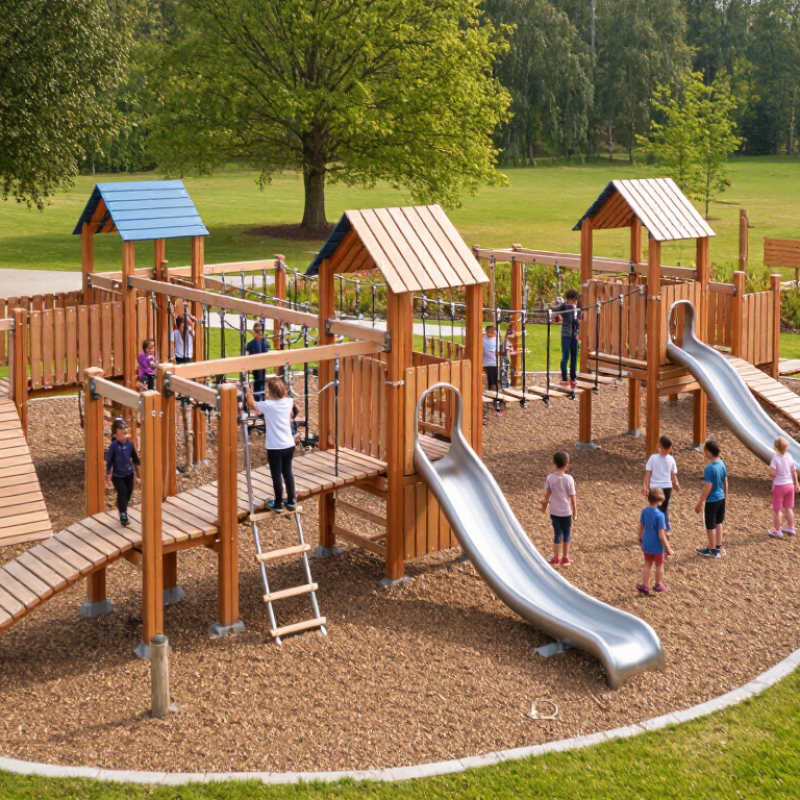
2026 Best Wooden Playground Manufacturers for Global Buyers?

What Defines a Wooden Playground Manufacturer in 2026?

A wooden playground manufacturer in 2026 must offer more than attractive timber structures. It should demonstrate tested engineering, responsible sourcing, and clear maintenance planning. The WHO 2020 physical activity guidelines recommend at least 60 minutes of moderate-to-vigorous activity daily for children aged 5–17. Play equipment should therefore support climbing, balancing, swinging, and imaginative movement, not just visual appeal.

Material evidence matters. The FAO Global Forest Resources Assessment 2020 recorded about 4.06 billion hectares of forest worldwide, but forest coverage alone does not prove responsible sourcing. Buyers should request chain-of-custody documents, moisture-control procedures, and treatment records for every timber batch. Hidden moisture can cause cracks, decay, and unstable joints. Small details matter.

Safety testing should reference standards such as EN 1176 or ASTM F1487, depending on the destination market. Yet a certificate is not proof of perfect installation. A reliable manufacturer provides impact-attenuation data, fall-zone drawings, accessible design options, and replacement-part guidance. The UN Convention on the Rights of Persons with Disabilities also supports inclusive participation, so access should be planned from the layout stage.

Manufacturers should provide measurable service records.

That part is often weak.

Digital manuals, inspection schedules, and spare-part availability improve long-term reliability. I would still question suppliers that only display polished renderings. Real expertise appears in drainage gaps, rounded edges, concealed fasteners, and honest limits on timber performance.
How to Assess Materials, Safety Standards, and Product Quality

For global buyers, wooden playground quality begins with material verification, not attractive photographs. Choose durable timber with documented species, moisture control, and traceable sourcing. Inspect end grain, knots, cracks, and connection points. A playground exposed to rain needs sealed surfaces, rounded edges, and coatings tested for harmful substances. Ask for treatment records and maintenance instructions.

Safety assessment should match the destination market. Request current test reports against relevant standards, such as EN 1176 or ASTM F1487. Check whether reports cover the exact model, dimensions, and materials being purchased. Verify fall heights, impact-absorbing surfacing, guardrails, entrapment gaps, and finger-safe clearances. Small gaps matter. They can create serious risks.

Product quality also depends on production discipline. Review welding or fastening methods, load-testing records, packaging protection, and replacement-part availability. During factory inspections, buyers should compare drawings with the finished unit. A polished sample may conceal inconsistent drilling or weak hardware. That happens. Independent inspection before shipment is worthwhile, although it cannot replace regular maintenance after installation. Require clear assembly drawings, batch identification, and photos of hidden joints. Ask difficult questions when documents look incomplete. Reliability is built through evidence, careful checking, and a willingness to reconsider an attractive low-cost offer.

Top Wooden Playground Manufacturers for Global Buyers

2026 Best Wooden Playground Manufacturers for Global Buyers

Top wooden playground manufacturers for global buyers should combine safe design, stable production, and proven export experience. Grand View Research estimated the global playground equipment market at about USD 5.3 billion in 2023, with continued growth through 2030. This expansion increases supplier choice, but quality can vary sharply. Buyers should request timber species, moisture records, coating specifications, and recent product testing. FSC-certified wood can support responsible sourcing, although certification alone does not prove playground safety.

Safety evidence matters more than attractive photographs. The U.S. Consumer Product Safety Commission reports that falls cause approximately 79% of playground injuries. Reliable manufacturers should therefore provide impact-attenuation results, platform load tests, and clear installation drawings. Their products should align with relevant requirements, such as ASTM F1487 or EN 1176, depending on the destination market. Check anchor details carefully. Weak foundations create expensive problems.

Experience appears in small details. Look for rounded edges, concealed fasteners, drainage gaps, replaceable ropes, and spare-part availability for at least several years. Kiln-dried timber is useful, but local humidity still affects movement and cracking. That point is often underestimated. Ask for factory audit records, quality-control photos, packaging plans, and references from similar climates. A dependable supplier also explains maintenance intervals instead of promising “maintenance-free” equipment. Grand View Research data shows market growth, yet growth does not equal reliability; independent inspection remains necessary before shipment and after installation.

2026 Best Wooden Playground Manufacturers for Global Buyers

This 100-point procurement benchmark reflects the main factors global buyers typically assess when comparing wooden playground manufacturers. Safety compliance, material durability, customization, installation support, and export capability are evaluated without using company or brand data.

How Customization, Shipping, and Installation Support Work

For global buyers, the best wooden playground manufacturer is not simply the lowest-priced supplier. Customization should begin with a measured site plan, age zoning, fall-height calculations, and local safety requirements. Grand View Research valued the global playground equipment market at approximately USD 5.7 billion in 2023, with steady growth expected through 2030. That growth increases supplier choice, but also makes technical comparison more important.

Ask for CAD drawings, timber treatment details, hardware specifications, and a clear revision process. Small changes affect container space, installation time, and compliance. Shipping support should include moisture protection, export packing, loading photographs, a parts list, and realistic delivery milestones. The World Bank’s Logistics Performance Index 2023 shows major differences in customs efficiency and infrastructure between countries. A supplier should therefore provide documents early, not after the vessel departs.

Delays are expensive.

Installation support needs more than a video link. Good manufacturers provide numbered components, foundation layouts, anchoring instructions, and remote guidance for local contractors. Products should be designed around relevant standards, such as EN 1176 or ASTM F1487, while buyers confirm local approval requirements.

In my experience, unclear ground conditions cause more trouble than complicated play features. That detail is often missed. I would also request spare fasteners and replacement timber guidance. No project is perfect; even a well-drawn plan may need adjustment after excavation. Reliability comes from admitting that risk and documenting the solution.

How to Compare Pricing, Warranties, and Long-Term Value

2026 Best Wooden Playground Manufacturers for Global Buyers?

A low quotation can hide major costs. Compare the landed price, not only the factory invoice. Include packaging, ocean freight, customs duties, installation, safety surfacing, and local labor. Ask for a detailed bill of materials. It should identify timber species, hardware grades, coatings, and replacement parts. Vague descriptions create expensive surprises.

Warranty terms deserve careful reading. Some manufacturers cover structural timber for ten years, but exclude cracking, insects, water damage, and incorrect installation. Others offer shorter coverage with faster claim handling. Request examples of approved claims and response times. A reliable supplier should provide installation drawings, maintenance schedules, inspection guidance, and material traceability. Independent safety testing adds confidence, especially when equipment crosses regulatory markets.

Long-term value depends on climate and daily use. In humid regions, drainage gaps, sealed end grain, and corrosion-resistant connectors matter greatly. In colder areas, freeze-thaw movement can expose weak joints. Visit an operating playground if possible. Look at worn steps, loose bolts, faded coatings, and water collection points. These details reveal more than polished photographs. My own comparison process has sometimes favored attractive pricing too quickly. That is a mistake worth admitting. A stronger evaluation uses a five-year cost forecast, including recoating, spare parts, inspections, and downtime. The best manufacturer is not always the cheapest. It is the supplier whose evidence remains convincing after installation.

2026 Best Wooden Playground Manufacturers for Global Buyers? — How to Compare Pricing, Warranties, and Long-Term Value

An anonymized market-benchmark comparison for international sourcing and total-cost evaluation

Manufacturer Profile Typical Product Scope Indicative FOB Price per Set* Recommended User Age Common Safety Standards Structural Warranty Expected Service Life Typical MOQ Estimated Production Lead Time Long-Term Value Assessment
Profile A
Entry-Level Export Manufacturer
Small play towers Slides Swings
Solid softwood components with basic painted or stained finishes.
US$1,800–4,500 2–8 years ASTM F1487 or EN 1176 may be available for selected configurations; verify the exact model and test scope. 3–5 years for major timber components; shorter coverage may apply to coatings, hardware, and moving parts. 8–12 years with regular inspection, sealing, and replacement of wear parts. 1–3 sets 25–45 days after approved drawings and deposit ★★★☆☆
Lowest initial cost; higher maintenance and replacement risk.
Profile B
Standard Commercial Manufacturer
Multi-play systems Climbing elements Inclusive add-ons
Treated softwood or laminated timber with powder-coated metal accessories.
US$4,500–12,000 2–12 years ASTM F1487, EN 1176, or CSA Z614 documentation is commonly offered, subject to product configuration and destination market. 5–10 years for structural timber; commonly 1–3 years for finish, ropes, plastics, and hardware. 12–18 years when drainage, anchoring, surface protection, and scheduled maintenance are properly managed. 1 set or mixed container order 35–60 days ★★★★☆
Balanced purchase price, compliance options, and maintenance cost.
Profile C
Premium Solid-Timber Manufacturer
Large themed structures Custom layouts High-durability finishes
Selected hardwood or engineered timber, stainless-steel or heavy-duty galvanized hardware.
US$12,000–35,000+ 2–14 years Project-specific compliance packages commonly reference ASTM F1487, EN 1176, EN 1177, or CSA Z614. 10–15 years for primary structural elements; component warranties vary by material and use. 15–25 years with documented preventive maintenance and timely renewal of protective coatings. 1 custom project 60–100 days, including engineering and sample approval ★★★★★
Higher upfront investment with stronger durability and customization potential.
Profile D
Architectural Design Specialist
Destination playgrounds Nature-play systems Landscape integration
Bespoke timber structures coordinated with site circulation, shade, surfacing, and accessibility.
US$25,000–100,000+ 2–14 years, depending on zones Typically engineered against the applicable local standard; third-party inspection and site-specific risk assessment are often required. 10–20 years for engineered structural elements; separate terms normally apply to surfacing and specialist components. 18–30 years for well-designed projects with professional installation and an annual maintenance plan. 1 project 90–180 days, depending on design approvals and site conditions ★★★★★
Best for landmark projects; design, installation, and lifecycle planning drive the cost.
Profile E
OEM and Private-Label Supplier
Container-ready sets Custom packaging Retail or distributor programs
Standardized product platforms with configurable colors, panels, packaging, and documentation.
US$2,500–15,000 2–12 years Test reports may be available for selected models; buyers should confirm report validity, laboratory credentials, and model consistency. 3–10 years depending on the product tier; written exclusions for installation, misuse, weathering, and consumable parts are common. 10–18 years, strongly dependent on local installation quality and spare-parts availability. 5–20 sets or one mixed container 30–75 days ★★★★☆
Attractive for distributors; documentation and after-sales support require careful verification.
Profile F
Regional Project and Installation Partner
Supply and installation Site preparation Maintenance contracts
Procurement combined with local civil works, safety surfacing, assembly, inspection, and handover.
US$8,000–60,000+ installed 2–14 years Compliance is typically evaluated against the destination country's adopted playground standard and site inspection requirements. Usually 5–15 years for supplied structures; installation workmanship and surfacing may have separate coverage. 12–25 years when inspection, cleaning, tightening, drainage control, and coating renewal are included in the service plan. 1 project 45–120 days, including site preparation and installation scheduling ★★★★★
Potentially lowest project risk when local service capability is strong.
Buyer comparison notes: Prices are indicative 2026 international market ranges in U.S. dollars and normally exclude freight, import duties, taxes, safety surfacing, civil works, installation, and third-party inspection. Warranty periods are not equivalent to guaranteed service life. Before placing an order, request the exact material specification, moisture-treatment details, coating system, spare-parts list, installation drawings, maintenance schedule, insurance documents, and test reports covering the precise configuration. Final compliance should be confirmed for the destination country and the installed site.