How to Choose a Wooden Swing Set with Slide?
A backyard playset can turn an open patch of lawn into a favorite place for climbing, swinging, and imaginative play. Yet choosing a wooden swing set with slide involves more than comparing photos or counting accessories. The right fit depends on children’s ages, available space, the number of users, and how much upkeep you can manage. Measure the play area, including room for swings to move and children to exit the slide safely. Check the manufacturer’s recommended clearances and weight limits; these details vary by model. Small details matter.
Wood type, hardware, construction, and anchoring all affect how a set performs outdoors. Look for clear product specifications, sturdy connections, and instructions that explain assembly and ongoing checks. A smooth slide, secure handholds, and appropriately sized steps can make everyday play easier, but features should match the children who will use them. Also consider sun exposure, drainage, and whether the site is level. A set that looks solid in a product photo may need more space than expected. That is easy to overlook.
Wood can weather, and finishes may need attention over time, so review the care guidance before buying. Compare total costs, including delivery, installation, and suitable ground surfacing—not just the listed price. No single design suits every yard or family. This guide explores the practical questions to ask, helping you weigh comfort, safety, durability, and value before choosing a set for your home.
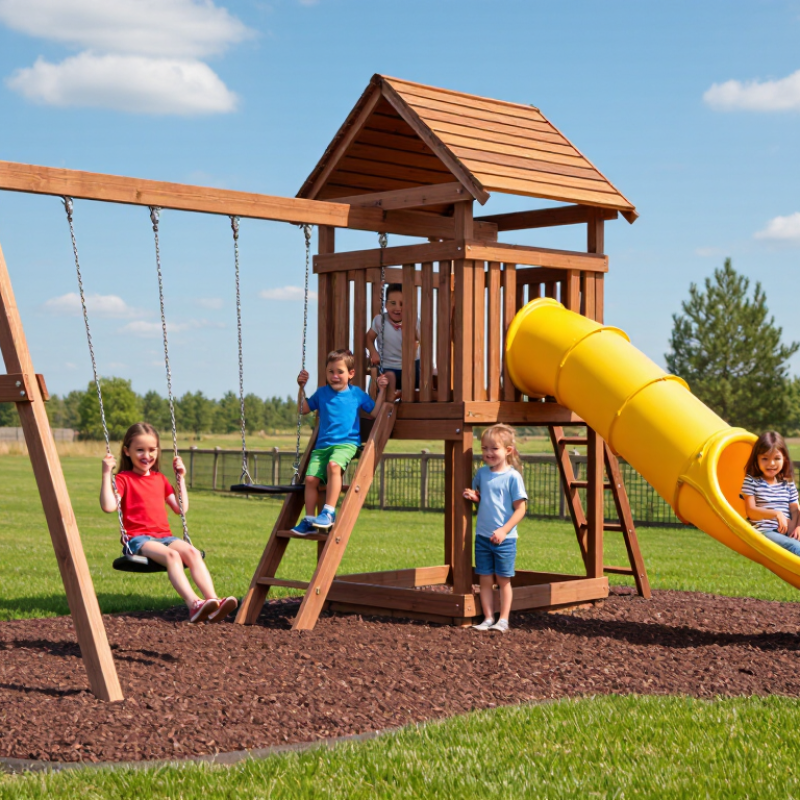
Assess Your Yard Space and Safety Clearance
How to Choose a Wooden Swing Set with Slide?
Assess Your Yard Space and Safety Clearance
Before comparing slide height or wood type, map the entire play area. Measure the set’s footprint, then mark the space where swings travel and children land. The U.S. Consumer Product Safety Commission’s Public Playground Safety Handbook (Publication 325) recommends a swing use zone extending in front and behind the swing by at least twice the distance from its pivot point to the protective surface. It also specifies at least six feet beside swing support structures. These are public-playground benchmarks, not a replacement for the set’s residential installation manual.
Measure twice. A sloping lawn can make a paper plan misleading. Check for fences, tree limbs, paving, garden walls, and windows within the proposed clearance area. Keep the slide exit open, and follow the manufacturer’s stated landing-zone dimensions; slide layouts vary. Leave room for an adult to walk around the structure and reach a child without squeezing between posts. I would recheck the measurements after marking them on the ground. It is easy to overlook a low branch or a gate that swings into the play space. The CPSC handbook offers useful safety guidance, but your yard’s shape still matters.
Compare Wood Types and Weather Resistance
When comparing wood types, focus on the actual lumber and its treatment, not just the species name. The USDA Forest Products Laboratory’s Wood Handbook explains that wood begins shrinking as it dries below its fiber-saturation point, roughly 30% moisture content. That matters on a swing set: repeated wetting and drying can loosen joints, widen checks, and make a slide’s supports less steady. Small details count.
Naturally durable heartwood, such as western red cedar, can resist decay better than many untreated woods, but sapwood is less dependable. Pressure-treated pine is another common option; check that cut ends and drilled holes receive suitable protection. The USDA handbook also cautions that durability varies within a species, so “cedar” alone is not a guarantee. Look for straight, sound boards, sealed end grain, and hardware that does not trap water. After rain, inspect the underside of platforms and the feet near the soil. Feel for soft spots. I would not assume a factory finish will last forever; it often needs maintenance sooner than expected.
Check Age Limits, Weight Capacity, and Safety Features
Choosing a wooden swing set with a slide starts with matching the equipment to the children who will use it. Check the stated age range, not just the photos or suggested activities. A preschooler may need lower platforms and easier steps, while older children may outgrow them quickly. Children change fast. Consider who might use the set over the next few years, too.
Read the weight limits carefully. Some sets list capacity per swing; others give a total limit for the whole structure. Ask how many children can play at once, and leave a sensible margin rather than treating the maximum as a target. Then inspect the safety details: secure railings, enclosed steps, smooth edges, sturdy swing connectors, and a slide exit with clear space. Install the set on level ground and use suitable impact-absorbing surfacing beneath swings and the slide. Follow the assembly instructions, anchor the frame as directed, and check bolts, wood, and hardware regularly for looseness, cracks, or splinters. A quick glance can miss wear. I would still recheck after heavy rain or a long winter; small shifts in the ground are easy to overlook.
How to Choose a Wooden Swing Set with a Slide
Start by checking the manufacturer’s age limits, weight capacity, and safety instructions for the exact model. The chart shows CPSC age categories for public playground equipment; they are useful context, not a substitute for a residential swing set’s own limits.
Before buying: Confirm the age and weight limits for each component, including the swings and slide. Look for secure anchoring, sturdy guardrails and barriers, and clear assembly and maintenance instructions. Install the set over appropriate impact-absorbing surfacing and follow the manufacturer’s clearance and inspection guidance. There is no single weight capacity that applies to all swing sets.
Age categories shown are CPSC classifications for public playground equipment. Always follow the residential product’s instructions and limits.
Review Assembly Needs, Maintenance, and Warranty
A wooden swing set’s assembly demands can matter as much as its design.
Check whether two adults are needed, whether the frame must be anchored, and whether the ground must be level. Count the parts and compare them with the manual before assembly. Small hardware is easy to miss. The CPSC’s Public Playground Safety Handbook lists 9 inches of engineered wood fiber for a 10-foot fall height. This is a public-playground reference, not a replacement for the set maker’s instructions; still, it shows why fall zones deserve attention around swings and slides.
Maintenance should be simple enough to do consistently.
Check bolts, chains, swing seats, slide joints, and timber for movement, cracks, splinters, or rot. Recheck after heavy rain or strong winds. Tighten loose hardware only as directed. ASTM F1148 covers safety performance for home playground equipment, but a standard cannot replace regular hands-on checks. A quick glance is not enough.
Read the warranty before choosing a set.
Compare coverage for wood, hardware, and plastic parts, and note any required care or exclusions. Keep the receipt, manual, and assembly photos. Ask whether normal weathering is covered; it often is not. This part can be frustrating. Annual sealing may also affect coverage, so confirm the care schedule in writing before opening the stain can.