Menu
Monday
9:00-5:00
Tuesday
9:00-5:00
Wednesday
9:00-5:00
Thursday
9:00-5:00
Friday
9:00-5:00
Saturday
9:00-4:00
Sunday
CLOSED
China has become a significant sourcing base for swing set accessories, serving playground builders, retailers, schools, and residential customers worldwide. Its manufacturing network includes accessory suppliers for swings, trapeze bars, climbing ropes, seats, chains, connectors, and protective components. However, product variety alone does not prove quality.
Dr. Donna Thompson, a recognized playground safety specialist, often stresses, “Supervision is the key to playground safety.” Her statement gives this market a practical direction. Reliable manufacturers should design accessories around safe grip distances, rounded edges, stable connections, and age-appropriate use. They should also provide clear installation instructions and traceable material information. A bright swing seat may look appealing, yet weak hardware can remain hidden inside the packaging.
This guide examines China’s top swing set accessories manufacturers through experience, technical capability, production consistency, and customer support. It considers stainless steel chains, weather-resistant plastics, powder-coated metal, rope strength, and replacement-part availability. Factory audits, sample testing, and communication records also matter. These details often reveal more than attractive catalog photographs.
The process is not perfect. Supplier websites can present limited or outdated information. Some factories specialize in custom orders, while others focus on high-volume standard products. Buyers must verify claims independently. Asking for test reports, factory videos, material samples, and recent project references can reduce uncertainty. It may feel slower, but careful checking protects children and budgets.
The best manufacturers do more than ship components. They help create durable, maintainable, and age-appropriate play systems. That difference deserves close attention.
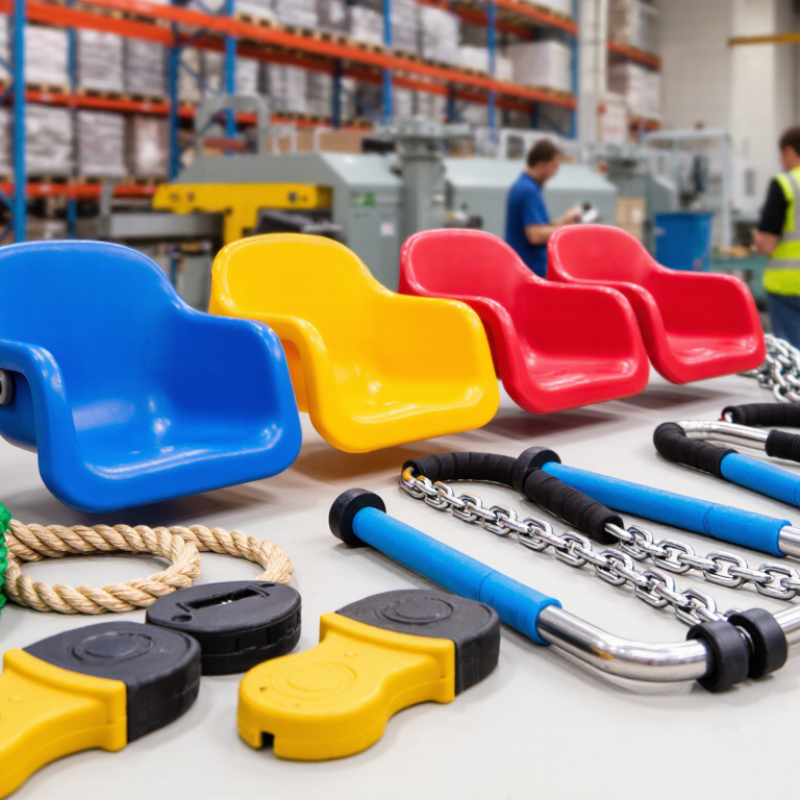
China swing set accessories manufacturers produce far more than replacement swings. Their product ranges commonly include belt seats, bucket seats, trapeze bars, climbing ropes, swing hangers, safety chains, ground anchors, and protective mats. Many factories work with steel, aluminum, molded plastic, rubber, and weather-resistant textiles. Each material serves a different purpose. Rubber seats feel softer, while powder-coated steel supports repeated outdoor use.
Manufacturers also produce accessories for different age groups and play environments. Toddler seats may include high backs, front bars, and adjustable straps. Older children may use rope ladders, gliders, gym rings, or flexible climbing nets. Factories often adjust colors, dimensions, hole positions, packaging, and installation hardware for distributors. Some provide samples, load testing, corrosion checks, and inspection reports before shipment. These steps help buyers verify product consistency instead of trusting photographs alone.
Practical experience still matters. A seat can pass a basic load test but feel uncomfortable after several minutes of use. A rope may look strong yet develop rough fibers near its connections. Not every factory catches these details. Buyers should inspect edges, fasteners, stitching, surface coatings, and instruction sheets. Clear installation guidance is essential, especially for anchoring systems and moving parts. I would also request replacement components, because small failures often occur in connectors rather than the main accessory. Further improvement is always possible.
China Top Swing Set Accessories Manufacturers
Reliable swing set accessories begin with material selection, not attractive colors. Galvanized steel brackets resist outdoor moisture, while stainless steel performs better in coastal environments. UV-stabilized HDPE seats help prevent cracking and fading under strong sunlight. EPDM rubber can soften impact around contact areas.
Ropes need strong, weather-resistant fibers and secure end coverings. Metal connectors should have rounded edges and protected threads. I have found that small details matter: a loose washer can create noise, movement, and eventually a safety concern. Manufacturers should test working loads, repeated swinging, corrosion resistance, and pinch-point protection. Product records should include material batches, inspection dates, and test results.
Applicable requirements vary by market. Buyers may review standards such as EN 1176 or ASTM F1487, depending on the installation environment and product category. These standards address issues including structural strength, entrapment risks, spacing, and impact protection. A factory audit is useful, but it is not enough. Request current test reports, inspect sample hardware, and compare the report with the actual accessory. Some suppliers provide excellent documents but inconsistent production. That possibility deserves attention. Clear installation instructions and routine inspection guidance also show professional responsibility. Safety labels should remain readable after exposure to rain, sunlight, and repeated cleaning.
Typical material density helps explain why different materials are selected for swing seats, chains, connectors, ropes, and protective surfaces. Lower-density polymers reduce weight, while metals provide strength and durable load-bearing performance.
Covers public-use playground equipment performance and safety requirements, including swing structures, entrapment hazards, impact zones, and structural integrity.
Provides general safety requirements and test methods for playground equipment, including access, stability, protrusions, falls, and user protection.
Accessories should resist corrosion, ultraviolet exposure, abrasion, repeated loading, sharp edges, pinch points, and deterioration during outdoor use.
Density values are typical reference values and may vary by alloy, grade, formulation, moisture content, and manufacturing process. Applicable requirements depend on the installation location and equipment classification.
Evaluating Chinese swing set accessories manufacturers requires more than comparing catalog prices. Start with the factory, not the sales brochure. Ask for production photos, material specifications, and recent quality records. A reliable manufacturer should explain steel grades, coating thickness, plastic composition, and connection methods clearly. Vague answers deserve caution.
Request samples before placing a large order. Inspect welds, edges, bolts, ropes, and moving joints by hand. Check whether surfaces feel smooth and consistent. Test color stability, rust resistance, and repeated movement under controlled conditions. Ask for independent test reports when available, but verify the issuing laboratory and test dates. Documents can look convincing.
Review the manufacturer’s quality process at each stage. Can workers trace incoming materials and finished batches? Are dimensions checked with calibrated tools? Does the factory record rejected parts? These details reveal practical experience. Also examine packaging, spare-part support, production capacity, and communication speed. A low price may hide thin coatings or weak after-sales service. I would not rely only on an impressive showroom; it can distract from ordinary production problems. Leave room for doubt. Ask one more question.
China’s leading swing set accessory manufacturers compete through controlled production, not low prices alone. Grand View Research reported that the global playground equipment market reached about USD 5.8 billion in 2022. This growth increases pressure on factories to document every material and process. Experienced manufacturers usually inspect steel tubes, molded seats, chains, fasteners, and packaging before assembly. Production records should include batch numbers, coating thickness, and load-test results. Small details matter.
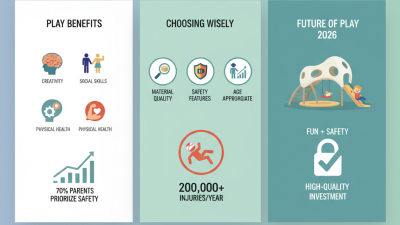
Customization begins with practical engineering. Buyers may request different seat shapes, chain lengths, colors, mounting plates, or carton sizes. Engineers normally review drawings, user weight, installation space, and drainage risks before producing samples. Computer models help, but physical testing remains essential. The U.S. Consumer Product Safety Commission reports roughly 200,000 playground-related emergency-room injuries annually, with falls representing a major cause. Manufacturers therefore test swing seats, connectors, and suspension points against applicable safety requirements, such as ASTM and EN standards. Certification alone is not enough.
Quality control should continue after mass production starts. Inspectors may use calipers, coating gauges, torque tools, and repeated-cycle testing. Random sampling can reveal hidden problems, but it cannot replace process discipline. A weak carton or poorly sealed fastener may damage an otherwise reliable product. Factories should also inspect weld appearance, sharp edges, corrosion resistance, and assembly instructions. The process is not perfect. Human inspection can miss defects, so traceable records, corrective actions, and independent audits provide useful protection for overseas buyers.
Industry reference table for swing-set accessory production, customization, testing, and quality assurance
| Manufacturing Area | Typical Materials or Process | Common Industry Reference | Customization Options | Quality-Control Check | Typical Record |
|---|---|---|---|---|---|
| Swing Seats | Injection-molded polyethylene, rubberized seats, or powder-coated metal frames | Outdoor playground safety requirements; impact-resistant and weather-resistant construction | Seat shape, color, surface texture, logo-free packaging, and age-range configuration | Visual inspection, dimensional measurement, edge-radius check, and static-load testing | Material certificate, inspection checklist, and load-test report |
| Suspension Chains | Low-carbon steel or stainless steel chain with zinc, electroplated, or polymer coating | Corrosion-resistant hardware with consistent link dimensions and secure end connections | Chain length, link diameter, coating type, connector style, and protective sleeves | Tensile sampling, link-gauge inspection, coating-thickness measurement, and rust screening | Batch number, tensile result, coating record, and incoming inspection report |
| Rope Assemblies | UV-stabilized synthetic rope, braided polyester, or high-strength fiber rope | Abrasion resistance, controlled elongation, secure termination, and outdoor durability | Rope diameter, color, end fitting, length, braid pattern, and protective cover | Breaking-load sampling, abrasion review, knot or termination inspection, and length check | Rope specification sheet and final sampling report |
| Fasteners and Connectors | Galvanized steel, stainless steel, locking nuts, clevis pins, and safety washers | Positive locking, rounded exposed surfaces, corrosion resistance, and compatible thread fit | Thread standard, head style, plating, washer type, and anti-tamper configuration | Thread-gauge test, torque verification, dimensional check, and surface inspection | Hardware inspection sheet and torque-control record |
| Metal Components | Steel tubing, stamped brackets, welded plates, and powder-coated structural parts | Controlled weld quality, smooth edges, stable geometry, and durable outdoor coating | Tube diameter, bracket geometry, mounting-hole pattern, coating color, and surface finish | Weld visual inspection, dimensional check, coating adhesion test, and load verification | Welding checklist, coating report, and dimensional inspection record |
| Plastic Protective Parts | UV-stabilized polypropylene, polyethylene, PVC, or thermoplastic elastomer | Impact resistance, low-temperature performance, color stability, and non-sharp edges | Color matching, texture, protective-cap geometry, drainage features, and packaging format | Visual inspection, dimensional sampling, impact check, and accelerated weathering review | Resin data sheet, color approval sample, and batch inspection report |
| Surface Finishing | Powder coating, electroplating, hot-dip galvanizing, or outdoor-grade polymer coating | Uniform coverage, adhesion, corrosion protection, and resistance to outdoor exposure | Gloss level, color reference, texture, coating thickness, and multi-layer finish | Thickness measurement, cross-hatch adhesion test, gloss check, and salt-spray screening where specified | Coating batch record, color approval, and laboratory test result |
| Tooling and Prototyping | CAD development, CNC samples, 3D-printed prototypes, and production molds | Design verification before mass production and controlled revision management | Dimensions, mounting interface, ergonomic profile, material selection, and assembly method | First-article inspection, fit-and-function review, design-risk assessment, and sample approval | Approved drawing, revision history, prototype sign-off, and first-article report |
| Assembly and Packaging | Semi-automatic assembly, torque-controlled tools, protective bags, cartons, and palletized loads | Correct component count, secure assembly, traceable labeling, and transport protection | Carton dimensions, multilingual instructions, barcode format, packing quantity, and inserts | Line inspection, torque sampling, carton drop review, quantity check, and label verification | Packing list, carton inspection record, and shipment-release checklist |
| Quality Management | Incoming inspection, in-process control, final inspection, and corrective-action procedures | ISO 9001-based quality systems are commonly used to organize documented controls | Inspection level, sampling plan, acceptance criteria, reporting format, and audit frequency | AQL sampling, nonconformance review, root-cause analysis, and corrective-action tracking | Control plan, inspection report, corrective-action record, and traceability log |
| Safety and Compliance Testing | Mechanical, chemical, flammability, and environmental testing according to destination market | ASTM F1148 and EN 71/EN 1176 may be relevant depending on product type and intended use | Test scope, documentation package, warning labels, installation instructions, and market-specific requirements | Load testing, entrapment review, sharp-edge assessment, chemical screening, and documentation audit | Test certificate, declaration of conformity where applicable, and technical file |
China Top Swing Set Accessories Manufacturers
Choosing the right Chinese supplier starts with evidence, not attractive catalog photos. The ISO Survey 2023 recorded more than 1.8 million ISO 9001 certificates in China, but certification alone does not prove product quality. Ask for current audit records, material certificates, batch traceability, and load-test reports for brackets, seats, ropes, and fasteners. Verify whether testing follows relevant standards, such as ASTM F1487 or EN 1176, for your target market.
The market data also deserves attention. Grand View Research reported steady growth in the global playground equipment market, with demand supported by public recreation and residential projects. This growth can attract inexperienced factories. Request a production sample before signing a large order. Inspect welds, rounded edges, coating thickness, drainage holes, and carton protection. A sample should survive practical handling, not only look polished in a factory video.
My first supplier shortlist focused too heavily on unit price. That was a mistake. Freight, replacement parts, inspection fees, and delayed deliveries changed the real cost. Compare landed cost instead. Ask suppliers to quote identical specifications and delivery terms. Check their monthly capacity during peak season, response time, and willingness to correct defects. Small details matter. A supplier that documents one missing washer may be more reliable than one offering the lowest price. However, even a careful supplier needs independent inspection before shipment. Supplier selection is never completely comfortable. That uncertainty should be managed with records, testing, and clear acceptance criteria.